
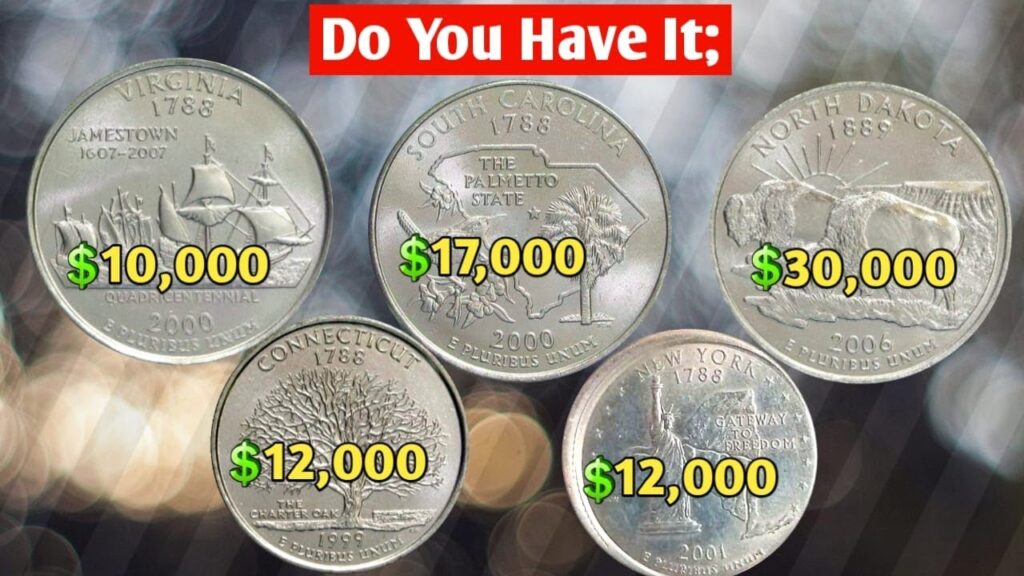
Most people spend quarters without thinking twice. But during the famous 50 State Quarters Program, a few minting mistakes slipped into circulation — and some of those coins later sold for $10,000 to over $30,000. 💰
Even more exciting?
Many of these error coins were released into everyday circulation, meaning valuable examples may still be hiding in pocket change, coin jars, or bank rolls.
Below is a simple guide showing the top 3 valuable state quarter errors and how to identify them step by step.
🔥 Top 3 Valuable State Quarter Errors
🥇 2004-D Wisconsin “Extra Leaf” Quarter
💰 Potential Value: Up to $30,000+
One of the most famous modern coin errors is the 2004-D Wisconsin State Quarter Extra Leaf Error.
🔎 Why Collectors Love It
This coin features an unusual extra leaf on the corn stalk design.
Collectors recognize two varieties:
- 🌽 High Leaf
- 🌽 Low Leaf
Both appear to be caused by a die error during minting, creating an extra leaf that shouldn’t exist.
📈 Auction Example:
One certified coin graded MS66 reportedly sold for $32,900.
Because of its strong visibility and rarity, this coin is often considered the most famous state quarter error.
🥈 2005-P Minnesota “In God We Rust” Quarter
💰 Potential Value: $15,000 – $17,000+
Another interesting error appears on the 2005-P Minnesota State Quarter In God We Rust Error.
🔎 What Makes It Unique
A heavy die grease error partially removed part of the word TRUST, making the motto appear as:
“IN GOD WE RUST”
Key features include:
- Missing or weak “T” in TRUST
- Clear readable “RUST” instead
- Strong visual appeal
📈 Auction Example:
A high-grade coin reportedly reached around $18,800 at auction.
This error is popular because it’s easy to see without advanced equipment.
🥉 1999-P Delaware “Spitting Horse” Quarter
💰 Potential Value: $10,000 – $12,000
The 1999-P Delaware Spitting Horse Quarter was part of the very first design released in the state quarter series.
🔎 How to Identify It
A die crack creates a raised line extending from the horse’s mouth.
This line gives the appearance that the horse is “spitting.” 🐴
Important characteristics include:
- Raised crack from the horse’s mouth
- Clear visible line pointing outward
- More valuable in higher grades
📈 Auction Example:
One graded example reportedly sold for $12,075.
🔍 Step-by-Step: How to Identify Valuable Quarter Errors
If you want to start searching for error quarters, follow these simple steps.
🔎 Step 1: Use Magnification
A 10× magnifying loupe works best.
Look carefully for:
✔️ Extra leaves or design elements
✔️ Missing or altered letters
✔️ Raised cracks or unusual lines
✔️ Die chips or bumps
🔎 Step 2: Inspect the Edge and Rim
Next, examine the rim and edge of the coin.
Possible signs of mint errors include:
✔️ Broken rims
✔️ Collar cracks
✔️ Uneven or distorted edges
These features sometimes appear when a coin was struck incorrectly.
⚖️ Step 3: Check the Coin’s Weight
The normal weight of a U.S. quarter is:
⚖️ 5.67 grams (±0.10 g)
Large differences may indicate:
- An off-metal strike
- A planchet error
- A counterfeit coin
🚫 Common Red Flags to Avoid
Not every unusual coin is a true mint error.
Watch out for signs of damage such as:
❌ Artificial scratches
❌ Tool marks
❌ Incorrect metal color
❌ Flattened or fake doubling
Many coins sold online as “errors” are simply post-mint damage.
🪙 Best Places to Find Rare State Quarters
Collectors often search in places where coins circulate frequently.
Some of the best spots include:
🏦 Bank rolls – Buy rolls and search through them
🏡 Old coin jars at home
🏧 CoinStar reject trays
🎁 Unopened U.S. Mint sets from 1999–2008
Sometimes valuable coins sit unnoticed for years.
📜 Why Professional Grading Matters
Coins authenticated by professional grading companies often sell for much higher prices.
Trusted services include:
- 🏅 Professional Coin Grading Service
- 🏅 Numismatic Guaranty Company
Benefits of certification include:
✔️ Authenticity verification
✔️ Accurate grading
✔️ Higher buyer confidence
✔️ Potentially 3–5× higher sale prices
💵 Where Collectors Sell Valuable Error Quarters
| Value Range | Best Platform | Typical Fees |
|---|---|---|
| $10,000+ | Heritage Auctions | ~15% |
| $1,000 – $10,000 | GreatCollections | ~10% |
| Under $1,000 | eBay | ~12–13% |
Using the right selling platform can help maximize the coin’s final value.
🧭 Collector’s Treasure Takeaway
The State Quarter Program (1999–2008) created one of the biggest coin-collecting movements in U.S. history.
While most state quarters remain worth face value, a few rare mint errors have sold for five-figure prices.
So before you spend your next quarter:
🔍 Check the design
🔍 Look for unusual errors
🔍 Examine the coin carefully
That ordinary 25-cent coin might turn out to be worth $30,000 or more. 🪙💰
Leave a Reply