
🪙 Could America’s First Half Cent Really Be Worth Nearly $20,000?
One of the oldest coins ever produced by the United States Mint is making headlines again.
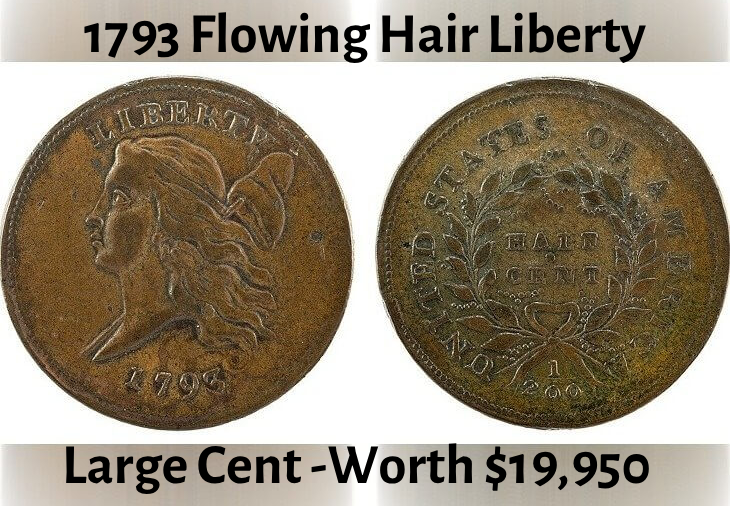
According to collector reports, a remarkable 1793 Liberty Cap Half Cent recently sold for $19,950 at a Texas auction, where it was purchased by a private coin collector from California.
Often mistaken for a 1793 Flowing Hair Large Cent, this historic copper coin is actually the much rarer 1793 Liberty Cap Half Cent—one of the very first coins struck by the newly established United States Mint.
Could one of these early American treasures still be hiding in an old collection?
Let’s take a closer look.
📚 In This Guide, You’ll Learn
✅ Why this coin is often misidentified
✅ The history of America’s first Half Cent
✅ How to identify a genuine 1793 Liberty Cap Half Cent
✅ What makes this early U.S. coin so valuable
🔍 Not a Large Cent—It’s a 1793 Liberty Cap Half Cent
Many online images incorrectly identify this coin as a 1793 Flowing Hair Large Cent.
However, collectors can quickly tell the difference by examining the reverse.
The genuine coin clearly displays:
✔️ HALF CENT
✔️ 1/200
A true 1793 Large Cent would instead read:
✔️ ONE CENT
✔️ 1/100
This important detail makes identification much easier for collectors.
🏛️ America’s First Half Cent
The 1793 Liberty Cap Half Cent was struck during the very first year the United States Mint began producing copper coins for circulation in Philadelphia.
Today, it remains one of the most desirable early American copper coins because of its:
🪙 Historic importance
🏛️ Extremely low survival rate
📈 Strong collector demand
✨ First-year issue status
⭐ Coin Specifications
Denomination
Half Cent ($0.005)
Year
1793
Designer
Liberty Cap – Facing Left
Metal Composition
100% Copper
Weight
Approximately 6.74 grams
Diameter
Approximately 22 mm
Edge Lettering
“TWO HUNDRED FOR A DOLLAR”
Original Mintage
Only 35,334 coins
Because of this relatively small mintage and more than two centuries of circulation, surviving examples are scarce.
🖼️ Design Features
Obverse
The front of the coin features:
👩 Liberty facing left
🧢 Liberty Cap behind her
⭐ Classic early American design
Reverse
The reverse displays:
🌿 Wreath surrounding the denomination
✔️ HALF CENT
✔️ 1/200
These details distinguish it from the 1793 Large Cent.
💰 Why Is It Worth So Much?
Several factors contribute to the coin’s impressive value.
Key Value Factors
🏛️ First-year U.S. Mint issue
🪙 Very limited original production
📈 High collector demand
💎 Historic significance
⭐ Surviving examples are increasingly difficult to find
High-grade specimens with original surfaces continue to command strong prices whenever they appear at major auctions.
🛒 Tips Before Buying or Selling
✅ Check the Reverse
Verify that it reads:
HALF CENT
1/200
✅ Examine the Edge
A genuine coin features the edge inscription:
“TWO HUNDRED FOR A DOLLAR”
✅ Avoid Cleaned Coins
Original surfaces are significantly more desirable to collectors.
✅ Buy Certified Examples
Choose coins authenticated by PCGS or NGC whenever possible.
🏆 Why Collectors Love the 1793 Liberty Cap Half Cent
Collectors consider this coin a cornerstone of early American numismatics because it offers:
🏛️ One of America’s first circulating coins
🪙 Historic first-year issue
📈 Long-term collector demand
💰 Outstanding investment potential
Very few U.S. coins tell the story of the nation’s earliest days as beautifully as the 1793 Liberty Cap Half Cent.
💎 Final Thoughts: A Historic American Treasure
The 1793 Liberty Cap Half Cent represents the beginning of federal coinage in the United States.
With its limited mintage, fascinating history, and enduring popularity, it remains one of the most desirable early copper coins for collectors. Whether selling for $19,950 or more, this remarkable Half Cent continues to remind us of the rich history behind America’s first coinage.
Happy collecting! 🪙✨


Leave a Reply