
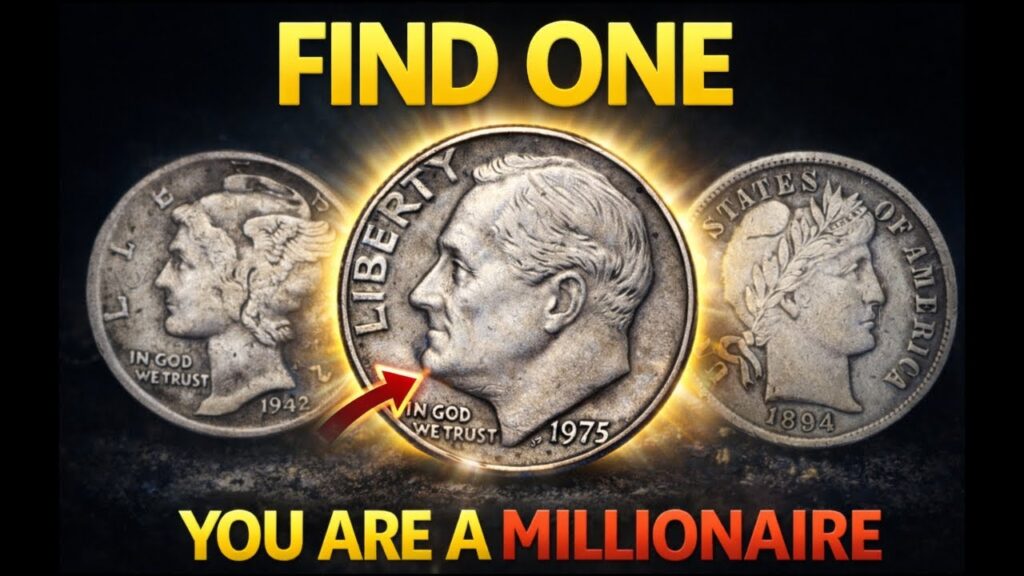
The $1,997,500 Dime: 3 Tiny U.S.
Most people spend their lives chasing money. Yet a single 10-cent coin has sold for nearly $2 million.
These are not rumors. These are verified public auction results. And the difference between pocket change and life-changing wealth often comes down to one tiny detail.
In this guide, you will discover:
✅ The exact coins to look for
✅ How to identify them step by step
✅ Their real, documented auction prices
✅ And how to avoid costly mistakes collectors still make today
Let us begin.
🥉 1. The 1975 Roosevelt Dime (No Mint Mark vs. “No S” Proof)
Two coins. Same year. Same design.
One is worth 10 cents.
The other is worth over $450,000.
Step 1: Understand the normal coin
Most 1975 dimes were made in Philadelphia and carry:
- No mint mark
- A dull, normal circulation finish
- No silver content
Millions were produced. In circulated condition, they are worth face value.
Step 2: Learn the “Full Bands” detail 🔍
On the reverse (back), look at the torch:
- Strong, sharp horizontal lines = Full Bands (FB)
- Flat or blurry lines = common strike
Only a tiny number were struck sharply.
📌 Record price (normal version):
A PCGS-graded MS67 Full Bands example sold for:
💵 $2,820
Purely because of condition and strike quality.
Step 3: The legendary coin – 1975 “No S” Proof 🚨
This is where history changes.
In 1975, San Francisco struck proof dimes that should all have an “S” mint mark.
But a few were made without it.
These coins:
- Are proof coins (mirror-like finish)
- Have frosted designs
- Have NO “S” mint mark
- Were accidentally released in proof sets
Only a handful exist worldwide.
📌 Verified auction prices:
- 💵 $456,000 (early sales)
- 💵 $56,250 (recent verified auction)
Collectors consider this one of the greatest modern U.S. mint errors ever discovered.
🥈 2. The 1942 Mercury Dime – Ordinary vs. Legendary Error
This dime shows Liberty wearing a winged cap (often mistaken for the god Mercury).
Most are common.
But two rare versions change everything.
Step 1: The high-grade “Full Bands” version
Most 1942 Mercury dimes were weakly struck.
Collectors look for:
- Razor-sharp horizontal bands on the reverse
- Extremely high mint-state condition
📌 Record price (normal version):
💵 $31,200
(PCGS MS68 Full Bands)
Step 2: The famous overdate error – 1942/1941 🔍
During production, the Mint reused a 1941 die.
The result:
- The date shows 1942 stamped over 1941
- Parts of the earlier date are visible under magnification
This variety went unnoticed for years.
📌 Record price (overdate version):
💵 $19,250
(PCGS MS66 Full Bands)
Even worn examples regularly sell for five figures.
🥇 3. The King of All Dimes – 1894-S Barber Dime 💎
This coin was never supposed to exist.
Yet it is one of the most valuable U.S. coins ever made.
Step 1: What makes it unique?
In 1894, the San Francisco Mint struck:
❗ Only 24 dimes
Not 24,000.
Not 2,400.
Just 24.
All were proof coins.
No official explanation was recorded.
Step 2: What happened to them?
- Some were given to bankers or officials
- At least one was reportedly spent on ice cream 🍦
- Most vanished forever
Today:
- Fewer than 10 examples are known
- Every coin is cataloged and authenticated
- None exist in circulation condition
Step 3: The historic price 🏆
📌 Highest verified auction sale:
💵 $1,997,500
Nearly $2 million for a 10-cent coin.
Other examples regularly sell for over $1 million.
This coin is valuable not because of silver…
Not because of age…
But because almost none exist.
🧭 How to know if your dime is valuable
✔ You likely have a normal coin if:
- It has a dull finish
- No mirror surfaces
- Common date and mint mark
🚨 You should act immediately if:
- Your 1975 dime is a proof with no “S”
- Your 1942 dime shows a 1941 under the date
- Your coin has razor-sharp “full bands”
- Your coin is an 1894-S Barber dime (extremely unlikely)
⚠ Important safety rules
- Never clean the coin
- Never sell it raw
- Never rely on casual opinions
Always use professional authentication and grading.
One correct identification can change your life.
📌 Final thoughts
Two coins. Same year. Same design.
One worth 10 cents.
One worth hundreds of thousands — or millions.
That is why collectors say:
Knowledge is the most valuable tool in numismatics.
The smallest coin can carry the biggest history.
Leave a Reply