
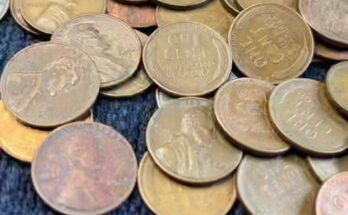
1943 Copper Lincoln Penny
Could a single penny really be worth more than $1 million? 🪙💰
A recently discovered 1943 Lincoln cent has generated excitement among coin enthusiasts after reportedly displaying several characteristics associated with one of America’s rarest coins. According to the owner, the coin weighs 3.1 grams, does not stick to a magnet, and appears to show significant doubling across its design.
If these observations are confirmed by professional experts, this could be an extraordinary discovery. However, it’s important to remember that authentication is essential before any value can be assigned.
Let’s examine why collectors are paying close attention to this fascinating coin.
🔥 Why the 1943 Lincoln Penny Is So Famous
During World War II, copper was needed for military production, so the U.S. Mint changed the composition of the Lincoln cent.
In 1943:
✅ Most pennies were struck on zinc-coated steel planchets
✅ Standard steel cents weigh approximately 2.7 grams
✅ Steel cents are magnetic
Because of this transition, any genuine 1943 copper (bronze) Lincoln cent is considered one of the rarest and most valuable U.S. coins ever produced.
⚖️ Step 1: Check the Weight
One of the first clues is the coin’s weight.
Reported Weight
3.1 grams
A bronze Lincoln cent normally weighs close to 3.11 grams, while a steel cent weighs about 2.70 grams.
📌 A weight near 3.1 grams can be consistent with a bronze planchet—but weight alone does not prove authenticity.
🧲 Step 2: Perform the Magnet Test
Another important test involves a simple magnet.
Reported Result
❌ The coin does not stick to a magnet.
This is significant because genuine 1943 steel cents are magnetic.
However, collectors should remember that counterfeit coins, altered dates, and plated coins can also fail the magnet test, making additional expert examination necessary.
🔍 Step 3: Look Closely for Doubling
According to the owner, the coin displays noticeable doubling.
Reported Features
- Double portrait
- Doubled date
- Doubling visible on multiple design elements
True doubled-die varieties occur during die production—not after the coin leaves the Mint.
If confirmed by specialists, such an error would make an already rare coin even more remarkable.
🌾 Step 4: Examine the Reverse Design
Collectors also compare the reverse of the coin with authenticated examples.
Important details include:
✅ Wheat ears
✅ Lettering
✅ Strike quality
✅ Surface appearance
Consistency across both sides helps experts determine whether a coin is genuine or has been altered.
💰 How Much Could a Genuine 1943 Copper Penny Be Worth?
Authentic 1943 bronze (copper) Lincoln cents rank among the most valuable U.S. coins.
Recent public auction records have shown examples selling for hundreds of thousands of dollars, and some exceptional specimens have exceeded $1 million, depending on factors such as authenticity, mint mark, provenance, condition, and market demand.
If this newly reported coin proves to be:
- ✅ A genuine 1943 bronze cent
- ✅ Professionally authenticated
- ✅ An unusual doubled-die variety
…it could attract tremendous interest from collectors and auction houses.
🏛️ Step 5: Professional Authentication Is Essential
Before any conclusions can be made, experts typically recommend several examinations.
Professional Evaluation May Include
✔️ Metal composition analysis
✔️ Accurate weight and diameter measurements
✔️ Die variety attribution
✔️ Microscopic inspection
✔️ Authentication and grading
Professional grading services such as PCGS and NGC are widely respected within the numismatic community for these evaluations.
🔍 How You Can Check a 1943 Penny
If you own a 1943 Lincoln cent, follow these basic steps:
✅ Step 1 — Check the Date
Confirm that the date is clearly 1943 and has not been altered.
✅ Step 2 — Use a Magnet
- Magnetic = usually a common steel cent
- Non-magnetic = deserves additional investigation
✅ Step 3 — Weigh the Coin
Approximate weights:
- Steel cent: 2.70 grams
- Bronze cent: 3.11 grams
✅ Step 4 — Inspect the Surface
Look for:
- Original color
- Signs of alteration
- Evidence of tooling
- Possible doubling
A quality magnifying loupe can make these details easier to see.
✅ Step 5 — Avoid Cleaning the Coin
Cleaning can permanently reduce collector value.
Instead:
✔️ Handle the coin carefully by its edges.
✔️ Store it in a protective holder.
✔️ Seek professional authentication if you believe it may be unusual.
💡 Collector Tips
🪙 Most 1943 pennies are common steel cents.
🪙 Genuine bronze examples are exceptionally rare.
🪙 Many counterfeit and altered-date coins exist.
🪙 Weight and magnet tests are helpful screening tools—but they are not enough to prove authenticity.
🪙 Always rely on professional authentication before assuming a coin has extraordinary value.
🌟 Collector’s Insight: Every Rare Discovery Begins with Careful Verification
Stories of million-dollar coins capture the imagination of collectors around the world, and the 1943 bronze Lincoln cent remains one of the hobby’s greatest legends. While a coin displaying the right weight, non-magnetic properties, and unusual characteristics is certainly exciting, extraordinary claims require extraordinary evidence.
The next step isn’t estimating its value—it’s confirming exactly what it is. Careful testing, professional grading, and expert analysis are what transform an intriguing discovery into a verified numismatic rarity.
Whether this coin becomes the next headline-making auction star or simply sparks more curiosity about coin collecting, it serves as a reminder that every old penny deserves a second look.
Happy collecting! 🪙✨
⚠️ Important Note
The claims in this article are based on the reported characteristics of the coin and have not been independently verified. A 3.1-gram weight, non-magnetic response, or apparent doubling does not, by itself, prove that a coin is a genuine 1943 bronze Lincoln cent. Authentication by a reputable grading service and, if necessary, metallurgical testing are essential before assigning any significant value.


Leave a Reply