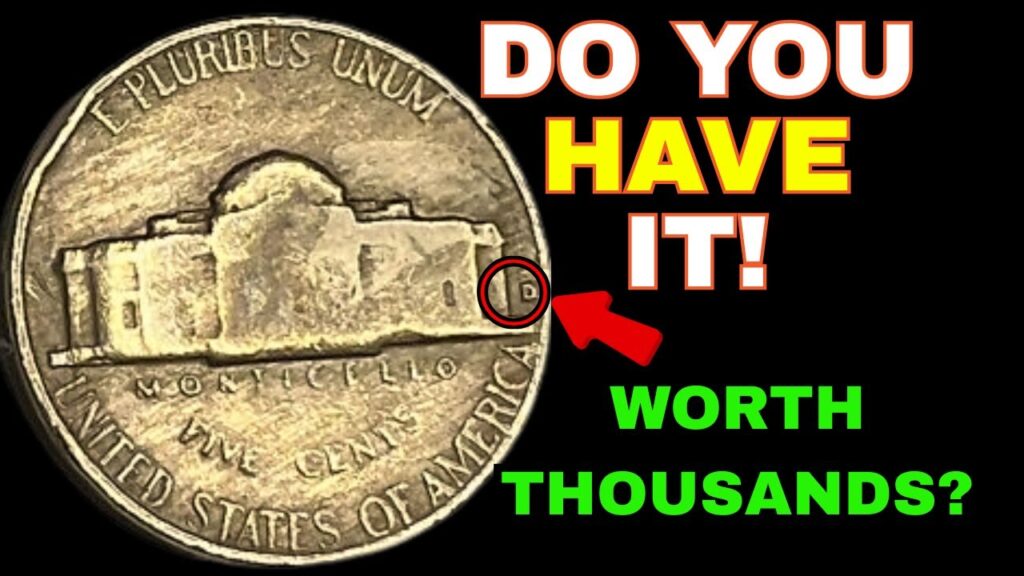
$19,800 Jefferson Nickel?
What if a coin in your pocket right now was worth thousands of dollars?
Not gold.
Not ancient silver.
Just ordinary Jefferson nickels that most people spend every day.
The difference between face value and a serious collector payday often comes down to one tiny detail most people never check: the steps on Monticello.
In this guide, you will learn:
✅ Which nickels matter
✅ What “Full Steps” really means
✅ How to identify valuable examples
✅ Real, verified auction prices
✅ And how to avoid costly mistakes
Let’s begin.
🔍 What “Full Steps” Means (And Why It Matters)
On the reverse of every Jefferson nickel is Monticello, Jefferson’s home.
At the base of the building are six steps.
To qualify as Full Steps (FS):
- The steps must be sharp
- Fully separated
- Unbroken from left to right
- Free of heavy marks
Most nickels fail this test because:
- Dies wear quickly
- Metal flow weakens
- High-speed production blurs details
That makes true Full Steps coins condition rarities, even for modern dates.
🥇 1. 1964-D Jefferson Nickel – Up to $19,800
Why this year matters
1964 was a crisis year for U.S. coinage. Americans were hoarding silver, and the Mint rushed production of base-metal coins.
Speed mattered more than quality.
What to look for
- Date: 1964
- Mint mark: D (Denver)
- Reverse: Monticello with strong, uninterrupted steps
Why it’s rare
Hundreds of millions were struck.
Only a tiny fraction survived with:
- Sharp strike
- Clean surfaces
- Full Steps
- High professional grades
Real auction results 💵
- 🏆 Record price: $19,800 (PCGS Full Steps, top population)
- Many others: $5,000 – $10,000
- Lower elite FS examples: $1,000 – $3,000
⚠️ Average circulated coins remain common.
🪙 2. 1943-P War Nickel – Over $10,000
Historical background
During World War II:
- Nickel was removed from coins
- A silver alloy was used instead
- A large mint mark above Monticello was added
- First time Philadelphia used a mint mark
What to look for
- Date: 1943
- Large P above Monticello
- Full Steps on the reverse
Why Full Steps are rare
The wartime silver alloy:
- Was softer
- Struck poorly
- Blurred details easily
Sharp steps are extremely uncommon.
Real auction results 💵
- 🏆 Record: Over $10,000
- Many sales: $5,000 – $9,000
- Lower FS examples: $1,000 – $3,000
🪙 3. 1985-P Jefferson Nickel – Up to $6,989
Why modern coins can be valuable
The Philadelphia Mint produced hundreds of millions of these.
High mintage does NOT mean high quality.
What to look for
- Date: 1985
- Mint mark: None (Philadelphia)
- Crisp, full steps under Monticello
Why collectors care
Only a microscopic percentage survived with:
- Full Steps
- No major marks
- Strong luster
- Top grades
Real auction results 💵
- 🏆 Record: $6,989
- High-end examples: $3,000 – $5,000
- Premium FS: $1,000 – $3,000
🪙 4. 1987-D Jefferson Nickel – Over $5,000
Why it’s overlooked
It looks completely ordinary.
That is exactly why people miss it.
What to look for
- Date: 1987
- Mint mark: D
- Fully separated steps
Real auction results 💵
- 🏆 Record: Over $5,000
- Many sales: $3,000 – $5,000
- Premium FS: $1,000 – $3,000
🪙 5. 1971-D Jefferson Nickel – Over $4,000
Why this coin surprises collectors
Early 1970s production emphasized quantity, not precision.
Full Steps examples are scarce.
What to look for
- Date: 1971
- Mint mark: D
- Sharp, uninterrupted steps
Real auction results 💵
- 🏆 Record: Over $4,000
- Many sales: $2,000 – $4,000
- Lower FS examples: $1,000 – $2,000
⚠️ Important Rules Before You Do Anything
If you think you found one:
❌ Do NOT clean it
❌ Do NOT polish it
❌ Do NOT sell it raw
❌ Do NOT trust casual opinions
✅ Use professional grading (PCGS or NGC)
One cleaning can destroy 90% of the value.
🧠 Final Thoughts
These nickels prove something powerful:
Rarity is not always about age or metal.
It is about survival, precision, and demand.
The most valuable coins often hide in the most ordinary places.
Your pocket change may already hold one.

Leave a Reply