1955 Doubled Die Penny
💭 The penny in your pocket is probably worth just 1 cent…
But if it has one specific microscopic detail — bold, dramatic doubling — it could be worth $150,000 or more.
We are hunting elite high-grade Wheat Pennies where flawless strikes and blazing red copper surfaces turn humble pocket change into six-figure treasure.
Before you spend another cent… read this carefully.
🥇 #1 – The Legendary 1955 Doubled Die Wheat Penny (No Mint Mark)
The most famous error in American coin collecting history is the 1955 Doubled Die Obverse Lincoln Cent.
Struck at the Philadelphia Mint, this coin carries no mint mark, which is completely normal for Philadelphia cents of that era.
But here’s where history was made.
💎 What Makes It So Valuable?
On the rare doubled die version:
- The date 1955 appears dramatically doubled
- The word LIBERTY shows bold separation
- The phrase IN GOD WE TRUST is clearly doubled
- The doubling is strong enough to see with the naked eye
This is NOT machine doubling.
This is a true doubled die — created during the die manufacturing process itself.
🔎 Step-By-Step Identification Guide
- Place the coin under bright white light
- Focus on the date — look for thick, separated numbers
- Check LIBERTY for rounded, bold doubling
- Inspect IN GOD WE TRUST for clear spread
- Confirm there is no mint mark
⚠️ Mechanical doubling looks flat and shelf-like.
The genuine 1955 doubled die shows deep, rounded separation.
📈 Verified Auction Records
- MS65 Red examples have sold for over $114,000
- Other elite red examples have crossed $100,000
- Even lower Mint State coins bring tens of thousands
These are documented public auction results from major houses like Heritage Auctions.
🥈 #2 – The $10,575 1950 No Mint Mark Wheat Penny
At first glance, the 1950 Lincoln Wheat Cent looks completely ordinary.
And in circulated condition — it is.
But in elite condition? Entirely different story.
🔍 What to Check
- Clear, sharp date (1950)
- No mint mark under the date
- Strong wheat ear detail on reverse
- Original red copper luster
A PCGS-certified SMS67+ Red example sold for $10,575.
Yes — over ten thousand dollars for a coin most people ignore.
Professional authentication by:
- Professional Coin Grading Service
- Numismatic Guaranty Company
is essential for maximum value.
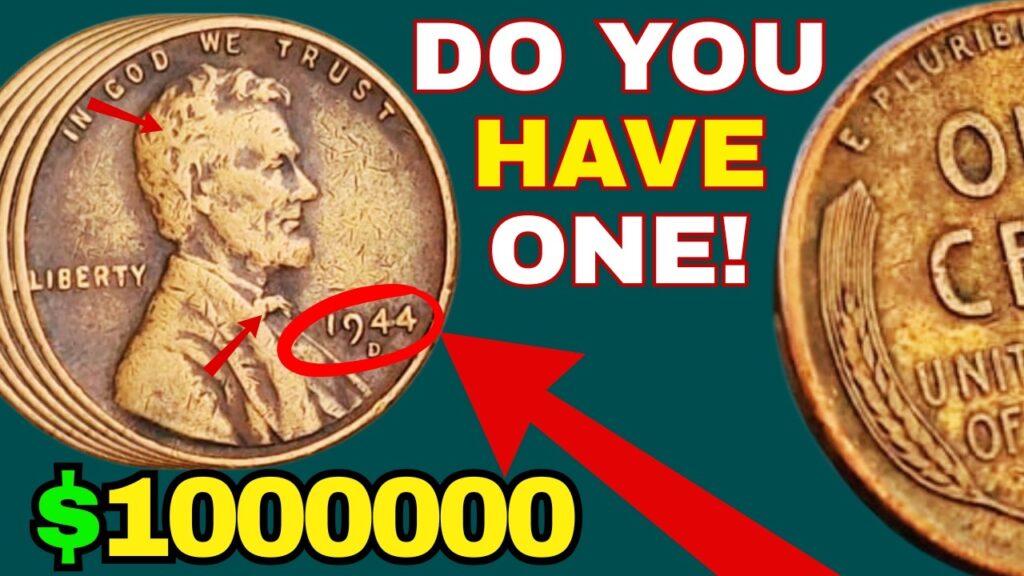
🥉 #3 – The $23,685 1944-D Wheat Penny Surprise
The 1944-D Lincoln Wheat Cent was struck during World War II.
Most are common.
But in pristine red Mint State grades?
Completely different story.
A PCGS-certified SMS67 Red example sold for $23,685 at public auction.
Key details:
- Look for the “D” mint mark
- Strong wheat lines
- Full original luster
- Minimal contact marks
Condition multiplies value dramatically.
🏛 #4 – The $19,200 1936 No Mint Mark Penny
The 1936 Lincoln Wheat Cent is common in worn grades.
But blazing red, fully original Mint State coins are rare.
One sold for approximately $19,200.
Even certain proof examples from 1936 have exceeded $21,000 at auction.
The difference?
Color.
Luster.
Surface preservation.
🔥 #5 – The $180,000 1944 Steel Penny Shock
Now here’s where things get dramatic.
The 1944 Steel Wheat Penny was mistakenly struck on leftover steel planchets intended for 1943.
This error is extremely rare.
One certified MS64 example sold for $180,000.
Important distinction:
- Normal 1944 bronze pennies are common
- The steel version is magnetic and silver-colored
- Only authenticated examples carry six-figure value
🧠 How to Protect a Potential Fortune
If you believe you found one:
✅ Never clean it
✅ Handle only by the edges
✅ Store in non-PVC holder
✅ Compare with certified examples
✅ Submit to PCGS or NGC
Cleaning can destroy thousands — even hundreds of thousands — in value instantly.
💎 Pocket Change or Hidden Gold?
Most wheat pennies are worth face value.
But elite survivors — with full red color, flawless strike, and certified authenticity — can command life-changing money.
Hidden treasure still circulates.
The question is…
Will you recognize it before you spend it?

Leave a Reply