1943 Copper Penny Worth
🪙 A Penny That Could Be Worth More Than a House?
Every serious coin collector dreams of finding one special coin — the kind that turns pocket change into a six-figure payday.
Recently, a collector sorting through an inherited Lincoln Wheat Cent collection discovered exactly that: a genuine 1943 copper penny.
Yes — the rare wartime error coin valued between $200,000 and $300,000+.
Here’s why this coin is so legendary — and how to determine if you might own one.
🔎 Why the 1943 Copper Penny Is So Rare
Most people are familiar with the common gray 1943 steel penny. But the copper version is one of the greatest mint errors in American numismatic history.
🏭 1️⃣ The WWII Metal Change
In 1943, during World War II, the U.S. Mint stopped using copper for pennies. Copper was urgently needed for:
- Military ammunition
- Electrical wiring
- War equipment
As a result:
👉 Nearly every 1943 Lincoln cent was struck in zinc-coated steel, not copper.
🔥 2️⃣ The Accidental Copper Strikes
A few leftover copper planchets (blanks) from 1942 remained in the minting presses.
By accident, these copper blanks were struck using 1943 dies.
Experts estimate fewer than 20 authentic 1943 copper cents exist across all mints (Philadelphia, Denver, and San Francisco).
That extreme rarity explains the massive price tags.
📊 3️⃣ 2025 Market Value
Depending on mint mark and condition:
- Lower-grade examples: $200,000+
- High-grade specimens: $300,000+
- Record auction results: Even higher when bidding intensifies
This is truly a life-changing coin.
But with high value comes high risk of counterfeits.
✅ Step-by-Step: How to Test a 1943 Copper Penny
If you think you’ve found one, follow these essential authentication steps before celebrating.
⚖️ Step 1 — Weigh the Coin (Critical Test)
- Genuine copper penny: ~3.11 grams
- Steel penny: ~2.7 grams
Even a small difference in weight is a major clue.
Use a precise digital scale (0.01g accuracy recommended).
🧲 Step 2 — Perform the Magnet Test
- Real copper 1943 penny: ❌ Will NOT stick to a magnet
- Steel 1943 penny: ✅ Strongly magnetic
If your “copper” coin sticks to a magnet, it is likely a copper-plated steel fake.
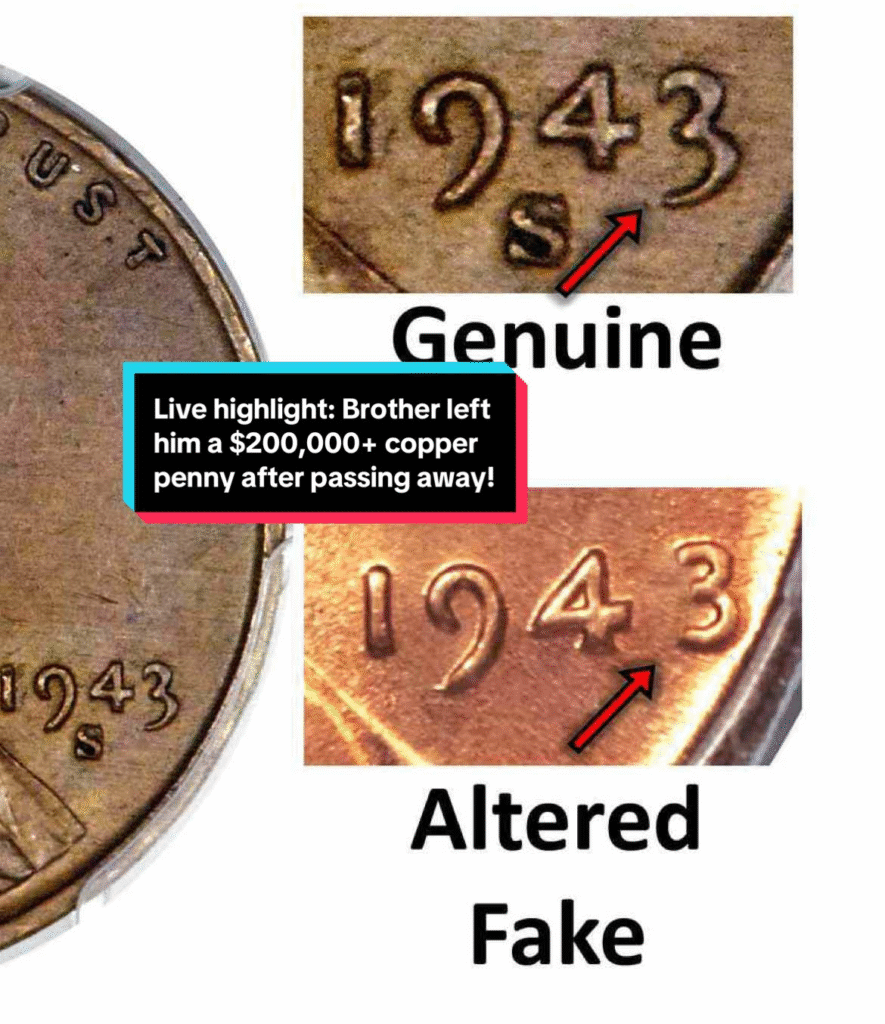
🔍 Step 3 — Inspect the Date Carefully
Most counterfeits are altered 1948 copper pennies.
Fraudsters grind down the “8” to resemble a “3.”
On authentic 1943 dies:
- The “3” curves slightly under the “4”
- The font matches other 1943 steel cents
- Spacing appears natural and not modified
Examine under magnification for filing marks or uneven metal.
⚠️ Warning: This Coin Is Frequently Counterfeited
Because of its enormous value, the 1943 copper penny is one of the most faked U.S. coins ever produced.
Common fake types include:
- Altered 1948 cents
- Copper-plated 1943 steel pennies
- Cast replicas from overseas
Even experienced collectors have been fooled.
🏛️ Professional Authentication Is Essential
If your coin passes the weight and magnet tests:
👉 Submit it immediately to a major grading service such as:
- PCGS (Professional Coin Grading Service)
- NGC (Numismatic Guaranty Company)
Only certified examples command full market value and auction-level prices.
🏆 Why the 1943 Copper Penny Remains a Numismatic Icon
This coin represents:
⭐ A rare wartime minting mistake
⭐ Extreme scarcity (fewer than 20 known)
⭐ Six-figure auction history
⭐ One of the greatest U.S. error coins ever produced
It’s more than a collectible — it’s a legendary piece of American history.
🔎 Before You Spend Another Wheat Penny…
If you own:
- Old penny jars
- Inherited coin albums
- Estate collections
- Lincoln Wheat cent rolls
Always check for 1943.
That small brown coin could be worth $300,000+.
One simple inspection could change everything. 🪙🔥

Leave a Reply